Of course your food photography needs to look beautiful.
But beautiful is only the beginning.
A successful food photograph needs to create expectations of an experience the viewer hasn't had yet.
The crunch of a crust. The softness of a sponge. The coldness of a drink. The stickiness of a glaze. The richness of a sauce. The freshness of fruit.
Before somebody tastes your food, orders a dish or picks up your product, their brain is already making predictions about what that experience might be like.
And those predictions begin with what they see.
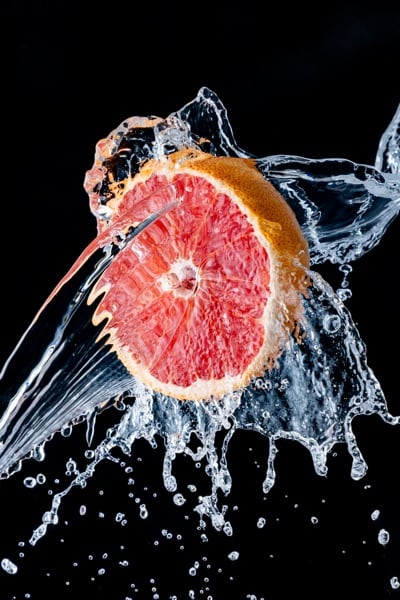
We Taste With Our Eyes Before We Taste With Our Mouths
Sight gives us an extraordinary amount of information about food.
And it starts happening remarkably quickly.
Research into visual perception has shown that our brains can begin categorising complex images in less than 150 milliseconds. Studies using food images have found similarly early responses, with differences in neural activity appearing within roughly 80–150 milliseconds of seeing a food cue. [1]
That's considerably less than the blink of an eye.
Before we've consciously stopped to study a photograph, our visual system is already processing information about what we're seeing.
Colour can suggest sweetness, bitterness, ripeness or freshness. Gloss can suggest moisture. Tiny highlights can reveal texture. Browning can tell us something is roasted, toasted or crisp. Condensation can make us expect a drink to be cold.
Scientific research has repeatedly shown that visual cues influence our expectations of food, including its taste, flavour, quality and other sensory characteristics. [2]
That's why photographing food isn't simply a matter of recording what is on the plate.
The photograph has to preserve, emphasise and sometimes carefully reveal the visual information that helps someone anticipate eating it.
A Photograph Can Even Change Your Saliva
This is where things get particularly interesting.
Seeing food doesn't produce a response only in your imagination. Your body can react too.
Research published in Food Research International in 2025 examined what happened to people's saliva when they looked at images of different foods.
The researchers found that exposure to food images changed the proportions of proteins present in saliva. Images of sweet foods, for example, increased levels of a particular salivary protein, while other changes were associated with how positively people responded to what they saw.
So yes, under experimental conditions, looking at pictures of food can actually change the chemistry of your saliva. [3]
Your eyes see an image. Your brain interprets what it sees. Your body can begin responding.
That's quite a lot for a photograph to achieve.

Pretty Is Only the Beginning
An attractive photograph might make somebody stop scrolling.
A successful food photograph should make them anticipate eating.
That creates a very different photographic challenge.
Does a crust look crisp?
Does a sauce look glossy or greasy?
Does bread look soft inside?
Does a steak look juicy?
Does a cocktail look cold?
Does chocolate look smooth and rich?
These aren't simply aesthetic questions. They're sensory ones.
The photographer has to understand which visual cues communicate those qualities, then use light, composition, colour, angle and detail to make sure the camera sees them.
Light Doesn't Simply Make Food Visible
Lighting is one of the clearest examples of why food photography is a specialist discipline.
Different foods and materials respond to light in completely different ways.
A soft, broad light might reveal the shape of one dish beautifully while making another look flat. Strong directional light can bring out the texture of a crust, but create distracting highlights somewhere else. Translucent ingredients can come alive when light passes through them. Dark food can lose important detail if the light isn't carefully controlled.
Then there are reflections.
Glassware, cutlery, polished plates, glossy sauces and bottles all reflect their surroundings.
You can't stop a reflective surface reflecting without changing its character. You have to decide what you want it to reflect.
That makes reflections part of the photograph rather than simply a technical problem to remove.
For drink photography in particular, those decisions help define the shape of a glass, show the colour and clarity of the liquid and make a bottle look three-dimensional rather than like a dark silhouette.

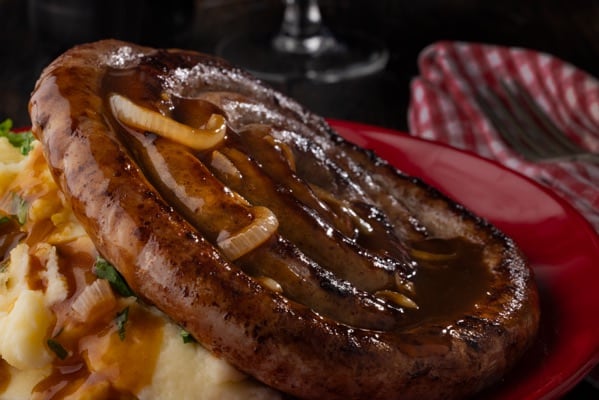
Sometimes We Want to See Every Crumb
Food photography has an interesting relationship with texture.
In portrait photography, lighting is often chosen to soften or reduce the appearance of pores, lines and surface texture.
Food can require almost the opposite approach.
A photographer might deliberately use light to reveal the bubbles in bread, the layers of pastry, the rough surface of a crumb, the fibres in pulled pork, the crystals on sugar or the tiny beads of moisture on fresh produce.
Those details give the brain clues about how the food might feel in the mouth.
Remove too much texture and a crisp surface can look soft. Flatten the highlights and something moist can look dry. Light a sauce badly and glossy can quickly become greasy.
The photograph can still be technically excellent.
It just might be saying the wrong thing about the food.
Colour Creates Expectations Before Flavour Arrives
We don't approach colour neutrally.
Through experience, we learn associations between colours and particular foods, tastes and flavours. Research has repeatedly found links between colour and expectations of sweetness, sourness, bitterness and other sensory characteristics. [4]
That doesn't mean there's a simple formula where one colour always produces one response. Context, culture, the food itself and previous experience all matter.
But colour gives the brain clues.
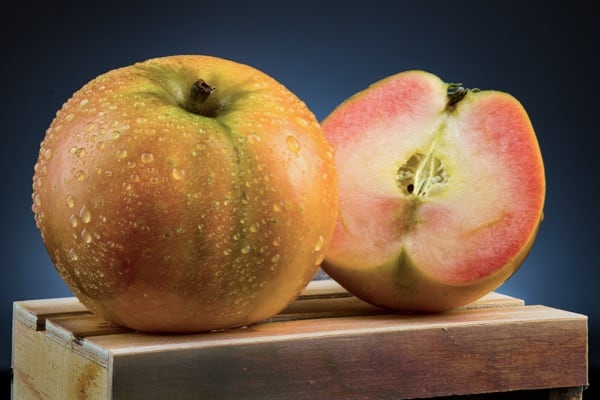
Think about cutting into an apple and discovering unexpectedly pink flesh.
Before you've taken a bite, the colour has already given you new information. You may start predicting something sweeter, sharper or simply different from the apple you thought you were about to eat.
A food photographer therefore has to treat colour as information.
Accurate colour matters, but so does the relationship between the food, plate, props and background. The aim isn't simply to create an attractive palette. It's to make sure colour supports the expectation the photograph is trying to create.
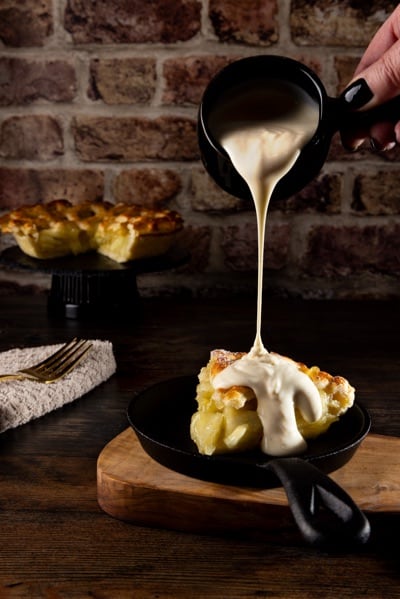
Movement Lets Your Brain Finish the Story
A stream of custard heading for a slice of pie.
Sauce being poured over pancakes.
Icing sugar falling onto a dessert.
A cocktail being poured into a glass.
These images capture only a fraction of a second, but we don't experience them as completely frozen events.
We anticipate what happens next.
Research has explored whether implied movement in food photography can influence perceptions of freshness, appeal and expected taste. Some studies have found an effect, although later research suggests it isn't consistent across all foods and images. [5]
For a photographer, movement can add something a static finished plate can't always provide. It introduces human interaction, anticipation and a sense that the food is about to be eaten.
Timing then becomes part of the photograph.
Too early and the action hasn't developed. Too late and the moment has gone. The useful fraction of a second can be surprisingly small.
The Camera Can Tell the Truth and Still Tell the Wrong Story
This is perhaps the most important point.
A camera can record exactly what was in front of it and still create an impression that doesn't match the food.
A perfectly crisp crust can look soft.
A juicy burger can look dry.
A beautifully clear drink can look dull.
A glossy sauce can look oily.
A carefully prepared dish can look flat and lifeless.
Nothing has been falsified. The photograph simply hasn't communicated the qualities that were present in the food.
That's why specialist food photography involves more than technical competence with a camera.
It requires an appreciation of how light, colour, texture, reflections, composition and timing affect what somebody expects the food to be like.
Does Specialist Food Photography Really Affect What People Think?
We wanted to test that question ourselves.
Independent consumer research carried out through Nottingham Trent University compared responses to the same products photographed professionally by JaxMore and without professional styling and lighting.
When participants viewed the professional images, they expected the products to cost an average of 40% more. Purchase likelihood increased from 2.9 to 4.0, while perceived quality increased from 3.1 to 3.7. [6]
The products hadn't changed.
What people expected from them had.
Those findings don't mean photography alone determines whether somebody buys, books or visits. Price, reputation, reviews, service and the quality of the food itself all matter.
But photography helps create expectations before any of those real-world experiences can begin.
So, Do You Need a Specialist Food Photographer?
A good photographer understands light, composition, colour and their equipment.
A food and drink specialist also spends their working life applying those things to subjects that melt, wilt, steam, drip, shine, reflect, change colour and lose their best appearance remarkably quickly.
More importantly, they learn to look beyond whether a photograph is attractive.
What will somebody expect this to taste like?
What will they expect the texture to feel like?
Does it look hot, cold, crisp, soft, juicy, fresh or rich?
Does the photograph communicate the quality the business wants its customers to expect?
Those are the questions that matter.
Because your food photographs should certainly look beautiful.
They should also make people hungry.
And, as it turns out, their saliva might have something to say about that too.
Read more about what to look for when choosing a food photographer.
Research Sources
This page draws on published research into visual perception, food perception and physiological responses to food imagery, alongside independent consumer research carried out using JaxMore photography.
[1] Thorpe, S., Fize, D. & Marlot, C. (1996). Speed of processing in the human visual system. Nature, 381, 520–522. DOI: 10.1038/381520a0. Zoon, H.F.A., Ohla, K., de Graaf, C. & Boesveldt, S. (2018). Modulation of event-related potentials to food cues upon sensory-specific satiety. Physiology & Behavior, 196, 126–134. DOI: 10.1016/j.physbeh.2018.08.020.
[2] Motoki, K., Spence, C. & Velasco, C. (2023). When visual cues influence taste/flavour perception: A systematic review. Food Quality and Preference, 111, 104996. DOI: 10.1016/j.foodqual.2023.104996.
[3] Marques, E., Simões, C., Pérez-Jiménez, M., Capela e Silva, F. & Lamy, E. (2025). Start looking at saliva: Effect of visualization of food images on salivary proteome. Food Research International, 209, 116301. DOI: 10.1016/j.foodres.2025.116301.
[4] Spence, C. (2015). On the psychological impact of food colour. Flavour, 4, 21. DOI: 10.1186/s13411-015-0031-3.
[5] Gvili, Y., Tal, A., Amar, M., Hallak, Y., Wansink, B., Giblin, M. & Bommelaer, C. (2015). Fresh from the tree: Implied motion improves food evaluation. Food Quality and Preference, 46, 160–165. DOI: 10.1016/j.foodqual.2015.07.015. Later replication research found that these effects were not consistent across a wider range of food images: Mulier, L. et al. (2021). Food on the Move: The Impact of Implied Motion in Pictures on Food Perceptions through Anticipated Pleasure of Consumption. Foods, 10, 2194.
[6] Nottingham Trent University (2026). Independent consumer research carried out as part of a consultancy project with JaxMore Food & Drink Photography, comparing consumer responses to professionally photographed and non-professionally photographed products.
ObscureMyEmail
ObscureMyPhone

Copyright © 2018-2021, JaxMore - All rights reserved
KTBB Limited trading as JaxMore Food and Drink Photography
Registered in England, no. 08828493
VAT no. 177253392
Registered Address: Carwood Park, Selby Road, Leeds, LS25 1NB


Made with ❤️ in Chellaston, Derbyshire. Hosted in the UK by Krystal using 100% renewable energy.


It’s and here you are again. Looks like our work’s stuck with you.
Why wait? Call or drop us a message today.
We are your visual advantage.
ObscureMyEmail
ObscureMyPhone
Privacy Settings
You are welcome to change your privacy preferences here.
Privacy Notice
We use tools to help us understand how our site is used and to make it better for visitors. No personal details are shared with us. For more information, see our Privacy Policy and Terms of Service.